
Review by David A. Sylvester
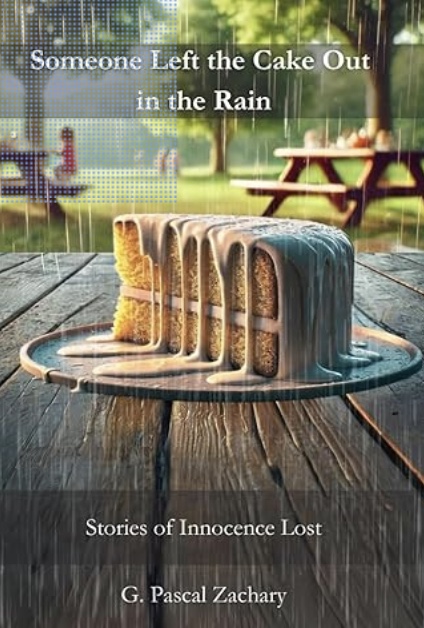
I’ve known Greg, aka G. Pascal Zachary, for many years as a reporter for the Wall Street Journal and a professor at Arizona State University, but in spite of this, or perhaps because of this, I was totally surprised by this wonderful collection of short stories he has just published under his own imprint with rather odd title, Someone Left the Cake Out in the Rain.
The best stories are among the most memorable I’ve read in a long time – and I’ve been teaching classic short stories for over a decade to students learning English. Greg’s stories focus on the relationships of people who are struggling in impoverished, often war-torn countries and the journalists, international workers, European tourists who visit and work there.
They meet, become friends, confidantes, lovers, and their lives become entwined, and emotions break through the barriers of circumstance, whether the relationship continues or lives on in memory. It is impossible, both for the characters and for us, the readers, to remain detached observers. Jean Vanier, the founder of L’Arche communities, predicted, in a different context: “You get to know the poor, they will ruin your lives because they will break your hearts.”
In the news, we hear a lot about the globalization of business, supply-chains, manufacturing, capital flows, even journalism and international aid programs, but this is transactional globalization. Underneath this surface, personal relationships are forging bonds that include the reality of national and cultural differences. In this way, we are witnessing, and Greg’s stories reveal, the emergence of a new globalization of multi-cultural consciousness.
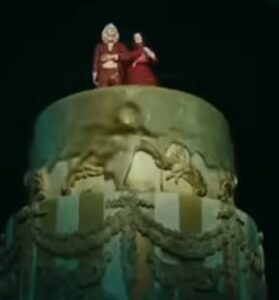
The title of the book comes from a line in the song “MacArthur Park,” a metaphor for the ruin of something precious through careless neglect. The song was originally written by Jimmy Webb and released in 1968 by Richard Harris. A decade later, Donna Summer’s version became a disco hit, and just recently, the song had another revival in the wedding scene of the 2024 Beetlejuice Beetlejuice movie. Greg calls his collection “stories of innocence lost,” but to my reading, it’s more about the precious I-Thou experience, to use Martin Buber’s phrase, when the Self encounters an Other. An intimacy develops and both incorporates differences but also suffers from the impersonal forces of circumstance, like state boundaries, distances, and material levels of living.
 This is evident in the desperate desires at the heart of Greg’s story, “From Chisinau, with Love.” Oksana Petrova, a talented multi-lingual translator, refuses to abandon her ”beloved, crumbling Chisinau,” the capital of Moldova where she lives. She turns down the opportunity to escape into the wider world with her lover, Maurice Leveque, an aid worker from Montreal, who must leave for a new position in Prague. “His arrogance offends her. He views life as a moveable feast, while she views life as a condemnation, a room with no door, a theater with no exit…”[1]
After he leaves, Leveque is haunted by his longing for Oksana, unsatisfied with emails or conversations over the static of the telephone. She makes one brief visit to see him in Prague but returns to Moldova and buys an apartment with all the rest of her money. The apartment turns into a disaster. Decrepit water pipes break, the place is flooded, and then comes the mold, the mildew and the stench. But she can’t give it up. “She owns the apartment and having been so long denied this right and having seen her father sent to Siberia for the pathetic crime of owning property, her ruined apartment is her new great love affair.”[2]
Leveque is now in Singapore but in one last futile telephone call, Oksana admits to him something she has never said before:
“She fears what lies beyond the boundaries of her world. She wants redemption in her homeland. She wants this more than love, wealth or adventure. And not merely personal redemption, but the redemption of her people, a people who one ever heard of, who were so twisted and smashed by World War II and its aftermath; a people the Soviets derided, a people who no longer know who they are and are haunted by the possibility that they may not be a people at all, only a creation of a paranoid dictator.”[3]
In “Leaving Kosovo,” we get a heart-breaking glimpse of the pain that remains for the inhabitants, especially the children, after the non-profit workers leave a village destroyed in the war. Dieter, a German aid worker in Kosovo, must go to his next assignment in Ghana, but not until he does one last thing: He takes a 12-year-old girl and her younger brother to visit the cemetery where all the other members of their family were buried after they died in a Serb bombing of their house.
Dieter, the children, and his driver stood there for a long time, huddled together for warmth, feeling the early chill of winter and death all around them.
“I’m glad I did not see them die,” Amaris finally said. “I am grateful for that.”
The boy wondered how many Serbs would have to die as revenge for his family’s murder. “Must all of them die, or just a few?”
Dieter ignored the boy’s question and instead took the boy in his arms and held him for a long time and then all of them returned to the car.[4]
On the way to the airport: Dieter betrays his conflicted feelings, the pain for his love of the children that he must abandon: “Get me out of here,” he told his driver sharply. “Take me to the airport.” [5]
The other stories are just as powerful:
“Ama”, a young woman searching for a way out of the poverty of Ghana, applies in the visa lottery at the U.S. embassy knowing only 3,000 were accepted out of thousands applying and as she walks away from the visa counter, “she implored God to explain why she was born in Ghana.”[6]
In “A Tro-Tro After Dark” a nurse goes out for an evening of dancing in the upscale, trendy Osu neighborhood of Accra, Ghana. It’s her only night out for the week, and she wanders around, then finds a courtyard with a band blaring Highlife music and a dance floor jammed with dancers. The lead singer is roaming the dance floor with a long-wire microphone and dances with her. “He sang to her while they danced, and she felt special.”[7] About midnight, she catches a “tro-tro,” a public minibus, to go home. Nothing in the story prepares you for the ending.
“The Harmattan” is named for a dry wind blowing sand and dust from the Sahara Desert south into West Africa during the winter months. Ama has a date with Jack, an obruni, a foreigner. An older woman warns her: “You talk, talk, talk about a visiting American, but he will come and go like the Harmattan winds, leaving you covered in dust. He will break your heart and leave you with only the taste of dust in your mouth.“[8]
The same themes of the globalizing of personal lives echo in other stories: “Amina’s Dream,” “The Elephant Man,” “Good News from Nigeria.” And this shouldn’t come as a surprise. In his memoir, Married to Africa: A Love Story, he tells the story of how he met Chizo Okon in Ghana, the woman who became his wife. Over the past 20 years, Greg has also written three other books based on his fascination with the globalizing world:
- The Global Me: New Cosmopolitans and the Competitive Edge, Picking Globalism’s Winners and Losers (2000)
- Multicultural Identity in the New World Economy (2003)
- Hotel Rwanda: The Politics of Escape (2012).
For most of his career, Greg wrote about technology and innovation, first as a reporter at the Wall Street Journal and later, a professor of practice at Arizona State University. His first book, Showstopper! The Breakneck Race to Create Windows NT and the Next Generation at Microsoft, was originally published in 1994 by Simon & Schuster, and over the years, it became an underground “techno-drama” classic. It describes the struggle of software programmers under pressure to develop a new operating system for Microsoft’s next decade. A new publishing imprint of Microsoft, 8080 Publications, is planning to release a second edition this April.
While working as a journalist, Greg says in his author’s note that he was always writing fiction. “Writing fictional stories is, for me, not merely an escape from the tyranny of facts and the relentless pressures of accuracy, sourcing and rational analysis. Fiction provides an alternate path to wisdom and to a different species of knowledge.”[9]
In this, he follows a long line of journalists who turned to short stories to explore the deeper layers of emotional reality that aren’t easily captured by reporting on facts and events. Historically, the short story genre emerged alongside journalism as some of the best-known writers of the late 1800s and early 1900s wrote both for the emerging mass circulation magazines. Mark Twain, Jack London, O. Henry, Stephen Crane, Ernest Hemingway all wrote journalism for newspapers and magazines, and their short stories reflected the themes and objective style of news reporting.
In making the transition from non-fiction to fiction, Greg naturally needs to spend some time in his early stories “clearing his throat,” as they say. He experiments with ways to portray the emotional qualities of life, sometimes by narrating character’s thoughts and feelings, and at other times, experimenting with the organization of the story form
In the end, he gives the most credit to the French writer Guy de Maupassant (1850-93) whose short stories served as a model for his own writing. You see this in “Her First Job,” a remarkably compressed and powerful story about an amateur bank robbery. Greg says the story was inspired by his interviews with women prisoners near San Francisco, a tradition that seems to come more from Crane or London or even some of Chekhov’s shorter pieces. The story begins with the words:
Virginia made the sign of the cross as she entered the bank on Clark Street.
She wanted some luck. She needed it. She was about to rob a bank.
It would be her first job.
And after this there would be others. The two men parked up the street had said so. [10]
However, I’ve been saving the best for last. To put it simply, “The Queen of the Maasai Trio” is amazing. A young Maasai woman narrates three life experiences to a group of listeners in an open-air cafe with a unique and powerful voice:
“My parents call me Queen because I am the last born and I am tall and slender and strong and lovely… I dream of killing a lion, killing a lion with a circle of boys, and then becoming a man among these boys, circling the lion one day as the sun comes down and joining with my boy-helpers to slice the lion’s throat and then drag the lion, rigid and hairy and heavy, back to our camp where we will be celebrated, and we will all become men.” [11]
These are mesmerizing voices that we need to hear.
<♦>
[1] Zachary, G. Pascal, Someone Left the Cake Out of the Rain, (Late Harvest Press, 2025, p. 106.
[2] Ibid., p. 110.
[3] Ibid., p. 111.
[4] Ibid., p. 117.
[5] Ibid., p. 118
[6] Ibid., p. 124
[7] Ibid., pg. 131.
[8] Ibid., p. 167
[9] Ibid., p. 267.
[10] Ibid., p. 30
[11] Ibid., p. 182-83
—–rescued from other field ——-
I’ve known Greg, aka G. Pascal Zachary, for many years as a reporter for the Wall Street Journal and a professor at Arizona State University. In spite of this, or perhaps because of this, I was totally surprised by this wonderful collection of short stories he has just published under his own imprint with rather odd title, Someone Left the Cake Out in the Rain.
The best stories are among the most memorable I’ve read in a long time – and I’ve been teaching classic short stories for over a decade to students learning English. Greg’s stories focus on the relationships of people who are struggling in impoverished, often war-torn countries and the journalists, international workers, European tourists who visit and work there.
They meet, become friends, confidantes, lovers, and their lives become entwined, emotions break through the barriers of circumstance. Whether the relationship continues or lives on in memory, it is impossible, for the characters, and for us, the readers, to remain detached. Jean Vanier, the founder of L’Arche communities, predicted, in a different context: “You get to know the poor, they will ruin your lives because they will break your hearts.”
In the news, we hear a lot about the globalization of business, supply-chains, manufacturing, capital flows, even journalism and international aid programs, but this is transactional globalization. Underneath this surface, personal relationships are forging bonds that include the reality of national and cultural differences. In this way, we are witnessing, and Greg’s stories reveal, the emergence of a new globalization of multi-cultural consciousness.
The title of the book comes from a line in the song “MacArthur Park,” a metaphor for the ruin of something precious through careless neglect. The song was originally written by Jimmy Webb and released in 1968 by Richard Harris. A decade later, Donna Summer’s version became a disco hit, and just recently, the song had another revival in the wedding scene of the 2024 Beetlejuice Beetlejuice movie.
Greg calls his collection “stories of innocence lost,” but to my reading, it’s more about the precious I-Thou experience, to use Martin Buber’s phrase, when the Self encounters the Other. An intimacy develops and incorporates their differences into the relationship. At the same time, they suffer from the impersonal forces of circumstance that separates and creates differences, like state boundaries, distances, and material levels of living.
This is evident in the desperate desires at the heart of Greg’s story, “From Chisinau, with Love.”
Oksana Petrova, a talented multi-lingual translator, refuses to abandon her ”beloved, crumbling Chisinau,” the capital of Moldova where she lives.
She turns down the opportunity to escape into the wider world with her lover, Maurice Leveque, an aid worker from Montreal, who must leave for a new position in Prague. “His arrogance offends her. He views life as a moveable feast, while she views life as a condemnation, a room with no door, a theater with no exit…”[1]
After he leaves, Leveque is haunted by his longing for Oksana, unsatisfied with emails or conversation
s over the static of the telephone. She makes one brief visit to see him in Prague but returns to Moldova and buys an apartment with all the rest of her money. The apartment turns into a disaster. Decrepit water pipes break, the place is flooded, and then comes the mold, the mildew and the stench. But she can’t give it up. “She owns the apartment and having been so long denied this right and having seen her father sent to Siberia for the pathetic crime of owning property, her ruined apartment is her new great love affair.”[2]
Leveque is now in Singapore but in one last futile telephone call, Oksana admits to him something she has never said before:
“She fears what lies beyond the boundaries of her world. She wants redemption in her homeland.
She wants this more than love, wealth or adventure. And not merely personal redemption, but the redemption of her people, a people who one ever heard of, who were so twisted and smashed by World War II and its aftermath; a people the Soviets derided, a people who no longer know who they are and are haunted by the possibility that they may not be a people at all, only a creation of a paranoid dictator.”[3]
In “Leaving Kosovo,” we get a heart-breaking glimpse of the pain that remains for the inhabitants, especially the children, after the non-profit workers leave a village destroyed in the war. Dieter, a German aid worker in Kosovo, must go to his next assignment in Ghana, but not until he does one last thing: He takes a 12-year-old girl and her younger brother to visit the cemetery where all the other members of their family were buried after they died in a Serb bombing of their house.
Dieter, the children, and his driver stood there for a long time, huddled together for warmth, feeling the early chill of winter and death all around them.
“I’m glad I did not see them die,” Amaris finally said. “I am grateful for that.”
The boy wondered how many Serbs would have to die as revenge for his family’s murder. “Must all of them die, or just a few?”
Dieter ignored the boy’s question and instead took the boy in his arms and held him for a long time and then all of them returned to the car.[4]
On the way to the airport: Dieter betrays his conflicted feelings, the pain for his love of the children that he must abandon: “Get me out of here,” he told his driver sharply. “Take me to the airport.” [5]
The other stories are just as powerful:
“Ama”, a young woman searching for a way out of the poverty of Ghana, applies in the visa lottery at the U.S. embassy knowing only 3,000 were accepted out of thousands applying and as she walks away from the visa counter, “she implored God to explain why she was born in Ghana.”[6]
In “A Tro-Tro After Dark” a nurse goes out for an evening of dancing in the upscale, trendy Osu neighborhood of Accra, Ghana. It’s her only night out for the week, and she wanders around, then finds a courtyard with a band blaring Highlife music and a dance floor jammed with dancers. The lead singer is roaming the dance floor with a long-wire microphone and dances with her. “He sang to her while they danced, and she felt special.”[7] About midnight, she catches a “tro-tro,” a public minibus, to go home. Nothing in the story prepares you for the ending.
“The Harmattan” is named for a dry wind blowing sand and dust from the Sahara Desert south into West Africa during the winter months. Ama has a date with Jack, an obruni, a foreigner. An older woman warns her: “You talk, talk, talk about a visiting American, but he will come and go like the Harmattan winds, leaving you covered in dust. He will break your heart and leave you with only the taste of dust in your mouth.“[8]
The same themes of the globalizing of personal lives echo in other stories: “Amina’s Dream,” “The Elephant Man,” “Good News from Nigeria.” And this shouldn’t come as a surprise. In his memoir, Married to Africa: A Love Story, Greg tells the story of how he met Chizo Okon in Ghana, the woman who became his wife. Over the past 20 years, Greg has also written three other books based on his fascination with the globalizing world:
- The Global Me: New Cosmopolitans and the Competitive Edge, Picking Globalism’s Winners and Losers (2000)
- Multicultural Identity in the New World Economy (2003)
- Hotel Rwanda: The Politics of Escape (2012).
For most of the time I’ve known him, Greg has focused on technology and innovation, first as a reporter at the Wall Street Journal and later, a professor of practice at Arizona State University. His first book, Showstopper! The Breakneck Race to Create Windows NT and the Next Generation at Microsoft, was originally published in 1994 by Simon & Schuster, and over the years, it became an underground “techno-drama” classic. It describes the struggle of software programmers under pressure to develop a new operating system for Microsoft’s next decade. A new publishing imprint of Microsoft, 8080 Publications, is planning to release a second edition this April.
While working as a journalist, Greg says in his author’s note that he was always writing fiction. “Writing fictional stories is, for me, not merely an escape from the tyranny of facts and the relentless pressures of accuracy, sourcing and rational analysis. Fiction provides an alternate path to wisdom and to a different species of knowledge.”[9]
In this, he follows a long line of journalists who turned to short stories to explore the deeper layers of emotional reality that aren’t easily captured by reporting on facts and events. Historically, the short story genre emerged alongside journalism as some of the best-known writers of the late 1800s and early 1900s wrote both for the emerging mass circulation magazines. Mark Twain, Jack London, O. Henry, Stephen Crane, Ernest Hemingway all wrote journalism for newspapers and magazines, and their short stories reflected the themes and objective style of news reporting.
In making the transition from non-fiction to fiction, Greg naturally needs to spend some time in his early stories “clearing his throat,” as they say. He experiments with ways to portray the emotional qualities of life, sometimes by narrating character’s thoughts and feelings, and at other times, experimenting with the organization of the story form
In the end, he gives the most credit to the French writer Guy de Maupassant (1850-93) whose short stories served as a model for his own writing. You see this in “Her First Job,” a remarkably compressed and powerful story about an amateur bank robbery. Greg says the story was inspired by his interviews with women prisoners near San Francisco, a tradition that seems to come more from Crane or London or even some of Chekhov’s shorter pieces. The story begins:
Virginia made the sign of the cross as she entered the bank on Clark Street.
She wanted some luck. She needed it. She was about to rob a bank.
It would be her first job.
And after this there would be others. The two men parked up the street had said so. [10]
However, I’ve been saving the best for last. To put it simply, “The Queen of the Maasai Trio” is amazing. A young Maasai woman narrates three life experiences to a group of listeners in an open-air cafe with a unique and powerful voice:
“My parents call me Queen because I am the last born and I am tall and slender and strong and lovely… I dream of killing a lion, killing a lion with a circle of boys, and then becoming a man among these boys, circling the lion one day as the sun comes down and joining with my boy-helpers to slice the lion’s throat and then drag the lion, rigid and hairy and heavy, back to our camp where we will be celebrated, and we will all become men.” [11]
These are mesmerizing voices that we need to hear. ♦
[1] Zachary, G. Pascal, Someone Left the Cake Out of the Rain, (Late Harvest Press, 2025, p. 106.
[2] Ibid., p. 110.
[3] Ibid., p. 111.
[4] Ibid., p. 117.
[5] Ibid., p. 118
[6] Ibid., p. 124
[7] Ibid., pg. 131.
[8] Ibid., p. 167
[9] Ibid., p. 267.
[10] Ibid., p. 30
[11] Ibid., p. 182-83